Benvenuto!
 I
wanted to share a very special day with you to bring
back memories of ancient traditions, the warm colorful
countryside, the spirit of festivals and the romance
of Tuscany. So with anticipation, John, a couple of
our friends and I (Max), woke up very early in the morning.
We were off to explore the ancient Malmantile village
which is 15 kilometers from Florence in the area of
Lastra a Signa. We saddled up the famous Maremma horses
with ‘La Scafarda’ which is the Italian
word for the cavalry-style military saddle. As the Butteri
or the Trail Guides directed us, we learned that this
saddle changed after the 2nd World War but was more
comfortable and longer lasting, fashioned with cowhide,
padded cushions and covered with a layer of leather.
We followed our Buttero, who guided the horse with one
hand, while the other held the ‘l’uncino’
or a short traditional stick used by the Butteri cowboys
to control their horses. Our horses were the typical
wild Maremmana breed that were strong, hardy and reliable
with withers over 165 cm being the usual Maremma race
whose color tended towards dark brown to black. I
wanted to share a very special day with you to bring
back memories of ancient traditions, the warm colorful
countryside, the spirit of festivals and the romance
of Tuscany. So with anticipation, John, a couple of
our friends and I (Max), woke up very early in the morning.
We were off to explore the ancient Malmantile village
which is 15 kilometers from Florence in the area of
Lastra a Signa. We saddled up the famous Maremma horses
with ‘La Scafarda’ which is the Italian
word for the cavalry-style military saddle. As the Butteri
or the Trail Guides directed us, we learned that this
saddle changed after the 2nd World War but was more
comfortable and longer lasting, fashioned with cowhide,
padded cushions and covered with a layer of leather.
We followed our Buttero, who guided the horse with one
hand, while the other held the ‘l’uncino’
or a short traditional stick used by the Butteri cowboys
to control their horses. Our horses were the typical
wild Maremmana breed that were strong, hardy and reliable
with withers over 165 cm being the usual Maremma race
whose color tended towards dark brown to black.
 So
John, our friends and I mounted our Maremma horses who
were named Lorenzo, Piero, Zufolo and Nibbio. We set
off down the shaded woody forest path just behind the
Villa Pandofini. As we climbed steadily uphill through
pine trees and ancient holm oaks, we reached the top
of the picturesque Colle Ubertini. This hill took us
through an exciting forest of pine trees past the stately
red country manor ‘Casa Rossa’ which originally
belonged to the Count Bardi family. We soon passed a
bubbling clear stream which is the source of the Fonteparti
aqua mineral that is bottled downstream. Our uphill
route took us past avenues of wild olive trees to a
fork in the road. We kept climbing uphill on our Maremma
horses till we reached a vineyard. Going through a romantic
‘filare’ or rows of plants, we saw hues
of green opening out to a stone wall. With the stone
wall on our left we followed the path for about a hundred
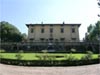
meters which led to a huge gate. An amazingly beautiful
sight met our eyes. We were right in front of the famous
Villa di Bellosguardo or the villa of the legendary
‘Caruso’, the famous tenor. So
John, our friends and I mounted our Maremma horses who
were named Lorenzo, Piero, Zufolo and Nibbio. We set
off down the shaded woody forest path just behind the
Villa Pandofini. As we climbed steadily uphill through
pine trees and ancient holm oaks, we reached the top
of the picturesque Colle Ubertini. This hill took us
through an exciting forest of pine trees past the stately
red country manor ‘Casa Rossa’ which originally
belonged to the Count Bardi family. We soon passed a
bubbling clear stream which is the source of the Fonteparti
aqua mineral that is bottled downstream. Our uphill
route took us past avenues of wild olive trees to a
fork in the road. We kept climbing uphill on our Maremma
horses till we reached a vineyard. Going through a romantic
‘filare’ or rows of plants, we saw hues
of green opening out to a stone wall. With the stone
wall on our left we followed the path for about a hundred
meters which led to a huge gate. An amazingly beautiful
sight met our eyes. We were right in front of the famous
Villa di Bellosguardo or the villa of the legendary
‘Caruso’, the famous tenor.
 Let
me tell you a lovely story about Lastra a Signa where
the Villa di Bellosguardo or the villa with a beautiful
view stands. Historical with a wealth of artistic endowments
of gorgeous churches, villas and country homes of the
nobles of the Middle Ages, Lastra a Signa had been the
retreat of famous people right through the Renaissance.
So it was natural that Enrico Caruso made this beautiful
Renaissance Villa Bellosguardo which was owned by the
Marquises Pucci for centuries, his hideaway in the hills.
Spectacular both outside and inside, the villa welcomes
you to step through its elegant doorway into its fabulous
rooms with soaring vaulted ceilings, sweeping staircases,
frescoed friezes and deep pastel pink velvet lined furniture.
Rich and ornate, the frescoed ballroom leads to the
Orangerie that is swept with a refreshing fragrance.
You can almost hear Caruso’s voice caressing and
haunting echoing through the lovely garden, the tree-lined
parks with fountains and the secret paths with mysterious
flower-filled arbors. We were especially overwhelmed
with the Renaissance loggia with wide views over the
gardens and Tuscan hills. The caretaker guided us through
the gravel ‘viale’ or the boulevard as we
reluctantly rode away unwillingly to leave this fabulous
sight. We went through the silent forest, each with
private thoughts about the hauntingly beautiful villa.
We entered a paved road which stretched for three kilometers
and an awesome vista dazzled our sight as we rode through
a picturesque meadow, past a forest of delicate cork
trees with a great 360-degree view of the countryside
around us. Let
me tell you a lovely story about Lastra a Signa where
the Villa di Bellosguardo or the villa with a beautiful
view stands. Historical with a wealth of artistic endowments
of gorgeous churches, villas and country homes of the
nobles of the Middle Ages, Lastra a Signa had been the
retreat of famous people right through the Renaissance.
So it was natural that Enrico Caruso made this beautiful
Renaissance Villa Bellosguardo which was owned by the
Marquises Pucci for centuries, his hideaway in the hills.
Spectacular both outside and inside, the villa welcomes
you to step through its elegant doorway into its fabulous
rooms with soaring vaulted ceilings, sweeping staircases,
frescoed friezes and deep pastel pink velvet lined furniture.
Rich and ornate, the frescoed ballroom leads to the
Orangerie that is swept with a refreshing fragrance.
You can almost hear Caruso’s voice caressing and
haunting echoing through the lovely garden, the tree-lined
parks with fountains and the secret paths with mysterious
flower-filled arbors. We were especially overwhelmed
with the Renaissance loggia with wide views over the
gardens and Tuscan hills. The caretaker guided us through
the gravel ‘viale’ or the boulevard as we
reluctantly rode away unwillingly to leave this fabulous
sight. We went through the silent forest, each with
private thoughts about the hauntingly beautiful villa.
We entered a paved road which stretched for three kilometers
and an awesome vista dazzled our sight as we rode through
a picturesque meadow, past a forest of delicate cork
trees with a great 360-degree view of the countryside
around us.
 Time
slowly but surely pulled us through its endless corridors
as we entered the quaint village of Artimino. A huge
tower rose up before us which was the look-out tower
used by the "protezione civile" or the civil
authorities as the look-out tower for fires and enemies
who surprised the inhabitants. Further down we saw the
beautiful Villa La Ferdinanda with its elegant lines
and façade built by Ferdinando I, Grand Duke
of Tuscany, who commissioned the project to Bernando
Buontalenti, the court architect in 1596. Typically
a Renaissance Florentine structure, the building is
characterized by an amazing feature of a 100 chimneys!
This lovely Medici villa was built by Lorenzo il Magnifico
for his family and his friends who loved to go hunting.
The Villa La Ferdinanda of "one hundred chimneys"
is outstanding because of a series of chimneys with
different forms and shapes were built at different angles
to provide warmth for its noble visitors at all times. Time
slowly but surely pulled us through its endless corridors
as we entered the quaint village of Artimino. A huge
tower rose up before us which was the look-out tower
used by the "protezione civile" or the civil
authorities as the look-out tower for fires and enemies
who surprised the inhabitants. Further down we saw the
beautiful Villa La Ferdinanda with its elegant lines
and façade built by Ferdinando I, Grand Duke
of Tuscany, who commissioned the project to Bernando
Buontalenti, the court architect in 1596. Typically
a Renaissance Florentine structure, the building is
characterized by an amazing feature of a 100 chimneys!
This lovely Medici villa was built by Lorenzo il Magnifico
for his family and his friends who loved to go hunting.
The Villa La Ferdinanda of "one hundred chimneys"
is outstanding because of a series of chimneys with
different forms and shapes were built at different angles
to provide warmth for its noble visitors at all times.
Inspired by this vision, we rode downhill for about
500 meters and then got off our Maremma horses as the
descent got steeper. We led the horses out into the
paved road and then again the past beckoned with its
ancient trail and we were lost in the mists of time
as we approached the old village of Malmantile. Time
stood still as Malmantile with its ancient roots traced
a medieval pattern. Quiet and still, there were no tourists
in this old fort. There were just a few shops, a school,
a pharmacy and a post office. This silent interlude
had sharpened our appetites and we ate a ‘panino
con salame e stracchino’ or a bread roll with
salami and rich cheese washed down with a Coke. This
nourishment would sustain us on the long ride back to
the Villa Pandolfini. We listened with awe as the locals
told us about the mysterious legends surrounding Malmantile.
The fortified medieval village whose origins are lost
in time is encircled by ancient town walls. The old
settlement was a military stronghold on the old road
that connected Florence with Pisa. It evolved into a
town and the story goes that the town sprouted from
as far back as the 4th century! We met some of the local
people and were very pleased when the owner of a 16th
century Cantina invited us for the inauguration of his
restaurant. We all trooped in and found to our surprise
a really long table that could seat thirty people. This
was the fratina table used by the monks of old. Anyway,
we were served a lot of good quality Chianti Colle Bertini
produced by the Fattoria and a menu stuffed with game
dishes among which was Sweet and Sour Hare/Rabbit. After
much merry making and bantering with a pleasant local
crowd, we set off after a filling dinner to have a coffee
in Florence. Normally when there is no traffic the ride
to Florence would just take barely 15 to 20 minutes.
As we approached Florence, we were shocked and surprised
to see mysterious almost Oriental lights twinkling and
a pagan air hung over the atmosphere. Almost forgetting
our coffee, we raced ahead to find that it was the Festa
della Rificolona. Interesting stories surround this
colorful festival. Held on September 7th, the traditional
Rificolona festival is held on the eve of the Feast
of the Madonna. Though it is a Florentine festival other
parts of Tuscany also celebrate this old 17th century
festival. Its origins go back to the times when the
farmers traveled to the city for the feast day. Invariably
they brought their wares to be sold in the open market
as part of the festivities. Since they had to start
almost before dawn to find an advantageous position
to market their produce, they made lanterns with canvas
or paper to light their way across the distances they
had to travel. This inspired the Florentines to make
lanterns resembling a long skirted female which swayed
from side to side on a pole. We walked around the streets
to find both children and adults parading the streets
with clappers, whistles and pea shooters to aim at the
lanterns causing them to burst into flames. At this
point, I must tell you that the word ‘fierucolone’
evolved into the name of the festival, ‘rificolona’
which is used in dialect to refer to women who are overdressed
or who dress in bad taste. The young men would throw
things at these lanterns till they caught fire. The
children made up little ditties like:
Ona, Ona, Ona,
O che bella Rificolona,
La mia l'é coi fiocchi,
La tua l'é coi pidocchi!
The translation reads:
Ona, ona ona,
What a beautiful Rificolona,
Mine with bows is tied,
In yours do lice reside!
We were delighted to see a traditional boat parade
sparkling with colored lanterns of all shapes and sizes
with prestigious prizes for the most original boat.
Even today traditional Rificolona laboratories are managed
by the City Wards to keep alive the tradition of lantern
making. The children make their own lanterns with colored
tissue paper and use their blowguns to shoot at farmers’
lanterns so that the candle would be knocked down and
the lantern would be set ablaze. We joined the parties
in the square and enjoyed the street theater performances
besides the lovely traditional food. The Festa della
Rificolona ends with a spectacular and colorful procession
from Piazza Santa Croce to Piazza Santissima Annunziata,
which is led by the Cardinal. After he addresses the
people, the revelry continues till dawn blazes through.
One of the main features is that this festival was first
organized by organic food producers in Italy and still
has sustained its momentum as one of the most important
festivals.
So, laden with big bags of organic food and other delicacies,
we made our way back to the Villa Pandolfini to try
out recipes with the wonderful produce from the Festa
della Rificolona. Welcome to the Good Tastes of Tuscany
cooking class where our expert chefs will conjure up
delicious dishes with the magic of the Festa della Rificolona.
Walk into the historical kitchen at the Villa Pandolfini
and witness a colorful parade of ancient recipes.
|