 Since
we always celebrate the spirit of craftsmanship at Villa
Pandolfini in creating wonderful traditional dishes
of Tuscany, I devised a secret plan to surprise my guests
with another equally exciting place. After a delectable
meal made under the instructions of our innovative chefs,
Liza and Maurizo and completed with a hands-on experience
by our guests, we chatted and laughed amicably in our
historical kitchen. I told my guests that they had done
a great job besides learning something new and I said
that they deserved a reward for their efforts. My guests
were so excited and could not wait to see the surprise
that I had planned for them. I announced that they would
go on a small excursion, but only I knew where! Since
we always celebrate the spirit of craftsmanship at Villa
Pandolfini in creating wonderful traditional dishes
of Tuscany, I devised a secret plan to surprise my guests
with another equally exciting place. After a delectable
meal made under the instructions of our innovative chefs,
Liza and Maurizo and completed with a hands-on experience
by our guests, we chatted and laughed amicably in our
historical kitchen. I told my guests that they had done
a great job besides learning something new and I said
that they deserved a reward for their efforts. My guests
were so excited and could not wait to see the surprise
that I had planned for them. I announced that they would
go on a small excursion, but only I knew where!
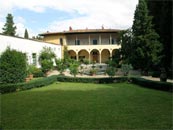 So
they followed me, chattering and whispering, wondering
where we were going. We walked from Villa Pandolfini
admiring the scenery and crossed the bridge over the
River Arno. Then after ten minutes, I turned into the
Museo della Paglia e dell'Intreccio "Domenico Michelacci"
– Signa. My guests were intrigued and looked around
in awe. Then as silence fell over our group, my guests
were totally amazed to learn that they were actually
standing in a place that unraveled the art of straw
plaiting and its varied uses. This skilled handicraft
was foreign to them and they traveled back in time to
absorb and appreciate the manufacture and evolution
from tempering the plain straw to its versatile creations. So
they followed me, chattering and whispering, wondering
where we were going. We walked from Villa Pandolfini
admiring the scenery and crossed the bridge over the
River Arno. Then after ten minutes, I turned into the
Museo della Paglia e dell'Intreccio "Domenico Michelacci"
– Signa. My guests were intrigued and looked around
in awe. Then as silence fell over our group, my guests
were totally amazed to learn that they were actually
standing in a place that unraveled the art of straw
plaiting and its varied uses. This skilled handicraft
was foreign to them and they traveled back in time to
absorb and appreciate the manufacture and evolution
from tempering the plain straw to its versatile creations.
Our little group was amazed as the mists of time took
them to the 1500s when straw plaiting was popular in
Tuscany. As this activity grew, it spread to Florence
and in the beginning of the 18th century through the
countryside of the "Piana", at Campo Bisenzio,
Sesto Fiorentino, Brozzi and also in Prato, Empoli,
Quarrata and to the Signe region. The factories at Fiesole
tried out innovative methods of plaiting called, ‘bigheri’
or ‘bigherini’, Swiss-type of plaits, mixed
with horsehair, cotton and silk. In Wolhen in Argovia
the peasants were already plaiting stalks of rye even
in the 1400s. As the production and commerce of straw
grew by the 1600s, many of the Swiss factories moved
to Florence that was known for its expertise. “But
who is Domenico Michelacci? His name is mentioned here,”
asked Tara, one of our English guests. I told her that
though straw hats were probably made from the 14th century,
it was Domenico Michelacci from Bologna who settled
in Signa in 1714, who was the innovative entrepreneur
responsible for the manufacture of the popular straw
hats. Domenico Michelacci learned the new methods of
cultivating and harvesting wheat that gave the opportunity
for the production of plait-able straw or ‘intreccio’.
Soon Signa became the center for this production and
the industry soon spread to Lastra a Signa, Montelupo,
Campi Bisenzio, Sesto Fiorentino, Prato, Montale, Carmignano,
Poggio a Caiano, Malmantile, Quarrata, Empoli, Fiesole
and Impruneta. Bearing the prestigious trademark of
"Made in Florence", these hats were shipped
to the far corners of the earth, down the River Arno,
through the port of Leghorn. “But
who is Domenico Michelacci? His name is mentioned here,”
asked Tara, one of our English guests. I told her that
though straw hats were probably made from the 14th century,
it was Domenico Michelacci from Bologna who settled
in Signa in 1714, who was the innovative entrepreneur
responsible for the manufacture of the popular straw
hats. Domenico Michelacci learned the new methods of
cultivating and harvesting wheat that gave the opportunity
for the production of plait-able straw or ‘intreccio’.
Soon Signa became the center for this production and
the industry soon spread to Lastra a Signa, Montelupo,
Campi Bisenzio, Sesto Fiorentino, Prato, Montale, Carmignano,
Poggio a Caiano, Malmantile, Quarrata, Empoli, Fiesole
and Impruneta. Bearing the prestigious trademark of
"Made in Florence", these hats were shipped
to the far corners of the earth, down the River Arno,
through the port of Leghorn.
Soon more than 80,000 straw manufacturing units mushroomed
through the Tuscan region by the end of the 18th century.
From 1924 to 1925-26, more than 142 million straw hats
were made and Signa became an important part of the
economy of Tuscany. “This is so interesting!”
exclaimed Henri, one of the cooking class guests. I
told him that this was the reason that the Museum was
established so that the authorities could house a venue
for the collecting, studying, restoration, conservation
and exhibition besides being a cultural center of a
traditional craft. The Township and the "Gruppo
Archeologico Signese" would together promote the
‘Treccia’ with a library, research center,
international meetings and conventions that would explore
the history of this extraordinary art and educate the
world.
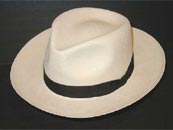 Did
you know that the expression, ‘Mad as a Hatter’
originated from the workshops of felt hats? This is
how a felt hat is made. First only specific breeds of
rabbit or hares are chosen. If the hat is to be made
from beaver skin, then it would require plucking of
the coarse guard hairs from the beaver pelt and brushed
with a solution of nitrate of mercury. This process
raises the scales on the fur shafts resulting in a firmly
locked stage. Known as "carotting", the process
if done in a badly ventilated room would increase mercury
fumes which could damage the brain, and that’s
how the expression "mad as a hatter" originated.
Then the fibers would be cut from the skin and placed
on a bench in a workroom known as the "hurdle".
The fibers called a hatter's bow would be suspended
over the bench like a huge violin bow and the fibers
would respond like the vibrations of a bow controlled
by the craftsmen and eventually separating and becoming
evenly distributed till it forms into a thick but loosely
woven or structured mat called the "batt".
The batts are taken and shaped into a cone and reduced
in size by boiling and rolling to create a firm dense
felt. The hood would then be sent to the hatter who
would mould it to the required shape and then line and
finish it. Did
you know that the expression, ‘Mad as a Hatter’
originated from the workshops of felt hats? This is
how a felt hat is made. First only specific breeds of
rabbit or hares are chosen. If the hat is to be made
from beaver skin, then it would require plucking of
the coarse guard hairs from the beaver pelt and brushed
with a solution of nitrate of mercury. This process
raises the scales on the fur shafts resulting in a firmly
locked stage. Known as "carotting", the process
if done in a badly ventilated room would increase mercury
fumes which could damage the brain, and that’s
how the expression "mad as a hatter" originated.
Then the fibers would be cut from the skin and placed
on a bench in a workroom known as the "hurdle".
The fibers called a hatter's bow would be suspended
over the bench like a huge violin bow and the fibers
would respond like the vibrations of a bow controlled
by the craftsmen and eventually separating and becoming
evenly distributed till it forms into a thick but loosely
woven or structured mat called the "batt".
The batts are taken and shaped into a cone and reduced
in size by boiling and rolling to create a firm dense
felt. The hood would then be sent to the hatter who
would mould it to the required shape and then line and
finish it.
 One
of the most important stages in felt hat making is forming
a cone and placing the necessary amount of fur on top
of the forming chamber or an upright cylindrical compartment
inside which a one-meter high copper cone is placed.
The cone has perforations and revolves slowly as an
exhaust fan is placed under it which sucks the air and
the loose fur into the chamber below and onto the revolving
cone. This process creates a matt of loosely interwoven
fibers. The cone is then immersed in a vat of very hot
water, which shrinks the fibers initiating the felting
process. The loose layer of fur is removed from the
cone. Though the unfinished felt hat is bigger than
the final one, it is subjected to many processes like,
folding, dipping in hot water and then finally put through
rollers, which squeeze out the excess fluid, which increases
the felting process. Then the Hood Blocking process
happens where the felt hoods are placed over wooden
blocks made from the American Poplar tree whose bark
is not grained. This is an expensive process as every
block costs two hundred pounds, as hat blocks have to
be made into different sizes and shapes and with the
creation of new styles the production investment increases. One
of the most important stages in felt hat making is forming
a cone and placing the necessary amount of fur on top
of the forming chamber or an upright cylindrical compartment
inside which a one-meter high copper cone is placed.
The cone has perforations and revolves slowly as an
exhaust fan is placed under it which sucks the air and
the loose fur into the chamber below and onto the revolving
cone. This process creates a matt of loosely interwoven
fibers. The cone is then immersed in a vat of very hot
water, which shrinks the fibers initiating the felting
process. The loose layer of fur is removed from the
cone. Though the unfinished felt hat is bigger than
the final one, it is subjected to many processes like,
folding, dipping in hot water and then finally put through
rollers, which squeeze out the excess fluid, which increases
the felting process. Then the Hood Blocking process
happens where the felt hoods are placed over wooden
blocks made from the American Poplar tree whose bark
is not grained. This is an expensive process as every
block costs two hundred pounds, as hat blocks have to
be made into different sizes and shapes and with the
creation of new styles the production investment increases.
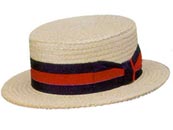 Now
the Flanging stage starts, which is the forming or creating
the brim. At first the brim is ironed and then cut to
the necessary width and placed on a wooden flange and
ironed again, dried and pressed. After this, the Stiffening
and Sanding process begins. Shellac is applied to the
brim according to the style of the design with more
shellac applied if the brim needs to be stiffer. In
cases such as fur-felt hoods, a smaller quantity is
applied as compared to wool felts. Then the hat is sanded
till it acquires a smooth texture that is characteristic
of soft fur felt hats. The last stage involves Trimming
with insertion of an inner leather band or lining of
material and a matching outer band. This is a very important
stage as it determines the character of the hat and
its wearer. Many additions and accessories can characterize
this feature to create a sense of style, individualism
and the going trends”. Now
the Flanging stage starts, which is the forming or creating
the brim. At first the brim is ironed and then cut to
the necessary width and placed on a wooden flange and
ironed again, dried and pressed. After this, the Stiffening
and Sanding process begins. Shellac is applied to the
brim according to the style of the design with more
shellac applied if the brim needs to be stiffer. In
cases such as fur-felt hoods, a smaller quantity is
applied as compared to wool felts. Then the hat is sanded
till it acquires a smooth texture that is characteristic
of soft fur felt hats. The last stage involves Trimming
with insertion of an inner leather band or lining of
material and a matching outer band. This is a very important
stage as it determines the character of the hat and
its wearer. Many additions and accessories can characterize
this feature to create a sense of style, individualism
and the going trends”.
We made our way back to the Villa Pandolfini in the
twilight and everything looked as soft and inviting
as a felt hat. I pulled my felt hat closer and said
that I felt privileged to be a Florentine. I am sure
my guests experienced an education that exposed and
illuminated an ancient craft that has survived the test
of time and remains today a priceless and artistic tradition.
|