Dear friends, students and readers,in this fall newsletter
besides the famous and classic wine of our friend Ilaria,
that is amazing, a must taste, we will indulge in relishing
Finocchiona, a perfect match with the unsalted bread
from Tuscany. We take you for a tasteful walk into the
heart of Tuscany with our delicious zucchini recipe
guaranteed to give you the true essence of the traditional
Tuscan countryside. Besides our travel of discovery
through herb gardens, we have infused the aroma of fennel
that can be used as a spice and an herb to add flavor
to cuisine. Florence adds to your adventure with the
spirit of romance by taking you to one of her popular
restaurants to add zest with dishes from ancient Tuscan
kitchens.
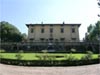
Villa Branca Chianti Classico Riserva
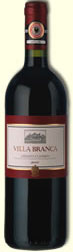 Villa
Branca is situated in the heart of the Chianti Classico
Belt. It is very close to Mercatele Val di Pesa, near
Florence. The vineyards produce many D.O.C. wines one
among them is the famous Villa Branca Chianti Classic
Reserve. The terrain is ideally suited to growing the
Sangiovese grapes, which are the local variety of grapes
used to make the Chianti wines. Villa
Branca is situated in the heart of the Chianti Classico
Belt. It is very close to Mercatele Val di Pesa, near
Florence. The vineyards produce many D.O.C. wines one
among them is the famous Villa Branca Chianti Classic
Reserve. The terrain is ideally suited to growing the
Sangiovese grapes, which are the local variety of grapes
used to make the Chianti wines.
Although the origins of the estate can be traced back
to a document from 1348, which states that it was owned
by the noble and ancient Florentine family of Buondelmonti
and acquired by Pierluigi Branca in the1950s.
Wine making is the primary focus of the estate. Sangiovese
grapes are the main variety grown here but other varieties
like Cabernet Sauvignon and Merlot e Petit Verdot are
also grown.
The cellars belong to the 14th century. The estate
has adopted a good mix of traditional methods of wine
making, together with modern techniques.
The Villa Branca Chianti Classico Riserva is a red
wine made mainly from Sangiovese grapes with additional
red grapes as allowed by legal specifications, which
govern the production of Chianti Classico.
The grapes are harvested between October 10th and the
20th. Then they are macerated in cement vats with frequent
and gentle stirring of the skins. They are fermented
at a temperature between 30-and 32 degrees Celsius.
They are then matured in 225 liter French oak barrels
for sixteen to eighteen months and then they are aged
for a year in cement vats. It is further aged in bottles
for six months.
The wine has a ruby red color with a full and spicy
aroma and a soft rounded taste with full-bodied tannins.
It makes a perfect accompaniment with game and aged
cheeses.
Finocchiona
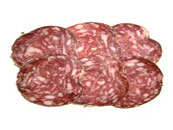 Finocchiona
is a typical pork sausage from the Florence and Chianti
region. It is definitely one of the most popular pork
products especially in Tuscan cuisine. It is used to
make many dishes. It is an integral part of the Antipasto
alla Toscana. Finocchiona
is a typical pork sausage from the Florence and Chianti
region. It is definitely one of the most popular pork
products especially in Tuscan cuisine. It is used to
make many dishes. It is an integral part of the Antipasto
alla Toscana.
First class pork from pigs bred in farms almost like
wild animals who consume natural products like maize,
barley and broad beans is generally used to make the
sausages. It is made using pork meat preferably from
the breast and shoulders of the pig. It is ground roughly
and seasoned with fennel, salt and pepper for one or
two months or even longer.
Fennel preferably wild fennel, which grows on wooded
hills and abandoned fields, gives Finocchiona its unique
and peculiar flavor. This is also how it derives its
name since fennel in Italian is “finocchio”.
Making Finocchiona is an ancient Tuscan tradition and
it is difficult to date its origins. It has been an
important part of all Florentine feasts including the
“Rificolona” in September and the “Scoppio
del carro” held in the Piazza del Duomo on Holy
Saturdays.
Finocchiona has an interesting but unsubstantiated
legend associated with its origins. It is said that
long time ago, a thief had stolen fresh salami near
the town of Prato. He hid it in a stand of wild fennel.
When he came to retrieve his loot he found that it had
absorbed the unique and wonderful flavor of the wild
fennel in which it had been hidden. Whatever be its
origin, the Finocchiona is one of the unique bounties
of Tuscan cuisine.
There are two types of Finocchiona. Sbriciolona, which
is very fresh and has an acquired taste and Finocchiona
proper which is firmer. Both of them can be accompanied
by almost any wine and will offer you an authentic slice
of Tuscan cuisine and Tuscan life.
Fennel
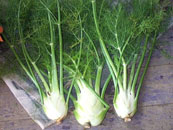 It
is considered as both a spice and an herb. It is found
growing naturally in Southern Europe especially the
Mediterranean and Southwestern Asia. It is widely cultivated
in many parts of the world and has many species including
the Florence fennel, which is called finocchio. It grows
in almost any kind of soil but the richer the soil,
the more tender the foliage. It
is considered as both a spice and an herb. It is found
growing naturally in Southern Europe especially the
Mediterranean and Southwestern Asia. It is widely cultivated
in many parts of the world and has many species including
the Florence fennel, which is called finocchio. It grows
in almost any kind of soil but the richer the soil,
the more tender the foliage.
The bulb, the foliage and the seeds of the fennel plant
have their own place in the cuisines of the world. The
leaves are used to flavor pork, veal and fish dishes.
They are also used in making fish stock, for making
sauces and stuffing, to add flavor to butter and salad
dressings and in making mayonnaise. The dried stalks
are sometimes placed under grilled or barbecued fish
for getting a uniquely flavored dish. The seeds are
used as a spice especially in breads. They are also
used as a mouth freshener in India.
The fennel seed has an anise-like flavor and aroma.
The seeds are yellow to greenish brown in color. The
main flavor is due to the presence of the essential
oil anethole.
It is very popular in Italy and is grown throughout
the year utilizing the high and low land areas. The
fennel seed is an essential ingredient in Italian sausages
especially the Finocchiona. The Florence fennel is also
a key ingredient in many Italian and German salads.
An easy Italian aperitif is to simply dip fennel segments
in olive oil.
The essential oils in fennel are used to treat chills
and cure stomach problems. It is used for respiratory
congestions and for cough remedies. As an infusion it
is used as soothing eyewash.
They are also used in some soaps and perfumes.
Alla Vecchia Bettola
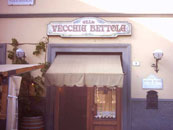 This
is one of the most popular restaurants in Florence,
which offers authentic and tasty Tuscan dishes in a
relaxed and friendly environment. This
is one of the most popular restaurants in Florence,
which offers authentic and tasty Tuscan dishes in a
relaxed and friendly environment.
It is situated within walking distance from most of
the famous monuments and attractions of Florence.
It is situated very conveniently outside the ancient
city wall on the Via Vasco Pratolini, in front of the
beautiful Torrigiani garden. It is located on the southwest
corner of Piazza Tasso, in the Oltrarno.
It has an ever-changing menu. It offers a very tasty
Bistecca and Crostini the Florentine way including the
popular appetizer Crostini di Fegatini di Pollo (chicken
livers on toast) and their antipasto Toscano which is
an array of incredible velvety and pungent cured meats.
Some other popular dishes include Penne alla bettola
in a spicy yet creamy tomato sauce, rigatoni dressed
with crushed olives or even Riso Rasticciole d’Agneilo
(a rice dish cooked in a halved sheep’s head)
which is very popular with the locals. Some seasonal
favorites are Anatra Riplena Tarturata (stuffed duck
in truffle sauce) and Carpaccio con Rucola (pounded
discs of beef piled high with argula and very thin slices
of pecorino cheese. Another favorite is Agnello con
Carciofi (lamb stuffed and rolled with artichokes).
The dessert range is also incredible but the favorite
is definitely the Tiramisu, which is the grand finale
to any sumptuous meal you may partake here. They also
offer a range of Tuscan wines to accompany all the courses.
It is a good place to spend a romantic evening.
It fills up quickly with fun loving as well as international
tourists. It is generally very popular so please make
a reservation otherwise you may have to go back disappointed.
It is closed for Easter, for three weeks in August
and from December 23rd to January 2nd. They do not accept
credit cards.
|